

Introduction
Section 11 of the Indian Contract Act,1872, defines the fundamentals of the capacity of the parties. The provisions of Section 11 need to be fulfilled for the parties to enter into a legally binding contract. In this article, we discuss what Section 11 of the Indian Contract Act, 1872, states, who are competent to enter into a contract, and what the exceptions to Section 11 of the ICA are. So, please stay tuned and read below.
Section 11 of the Indian Contract Act, 1872: competency to contract
Section 11 of the Indian Contract Act, 1872 defines that:
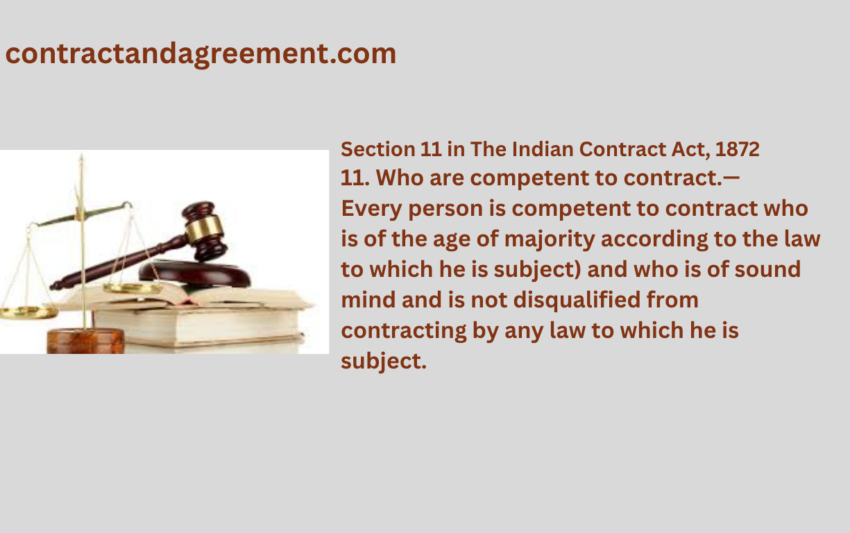
Each person who is of legal age is capable of contracting, or that person who has a sound mind and is not disqualified by law from entering into a contract.
According to this provision, the three criteria for competency of a party to the contract.
(1) Age of majority
(2) Sound mind
(3) Qualified by law
Before we discuss in depth the competency of a contract, first introduce what a contract is in basic terms:
A contract is a legally binding and enforceable agreement that is made between two or more parties. It is created with a mutual understanding to do something or refrain from some act. It also involves a promise and often involves consideration ( exchange of value) in terms of goods, services, or, in some cases, monetary value.
Key elements of a valid contract:
There are some key elements that we need to know for a valid contract, such as,
Offer and acceptance: One party make an offer, and another party clearly accept it.
Consideration: Exchange of value between the contracting parties.
Intention to create a legal relationship: The contracting parties must have an intention to create a legal relationship.
Free consent: An agreement must be made with free consent instead of coercion or fraud.
Capacity: The contracting parties must be legally capable of making a contract, such as legal age, having a sound mind, and not being disqualified from entering into a contract.
Lawful Object: The object or purpose of the contract must be legal.
All of these key elements are required to fulfill for making a legally valid contract. If, for any reason, the contract is broken, the injured party can pray for remedies, like compensation for damages, or specific performance of the contract from the court of law.
Section 11 of the Indian Contract Act, 1872:
The knowledge of competency to the contract is first described in section 10 of the Act. But, section 11 is an agreement with detail concept of the legal capacity of a person to enter into a contract.
Section 11 of the Indian Contract Act, 1872, is described below:
In simple we explain the section 11 of the ICA deals with the capacity of the party to enter into the contract. According to this, any person who has majority age as per the law, is of sound mind, and is not disqualified by law from entering into the contract.
Let’s understand this concept in depth:
Age of majority:
According to the provisions of section 11 of the Indian Contract Act,1872, only those people who have a majority age, as per the Indian Majority Act, 1875, are competent parties to the contract. In other words, the common rule of the age of majority is 18 years in India. That means a person who is not below 18 years is a competent party to enter into the contract. Individuals below the age of 18 years are not capable of entering into a contract. Because a person below the age of 18 years is considered a minor, and they lack the capacity to understand the terms and conditions of the contract. They also fail to know what the outcome of the contract. Therefore, the minor is not capable or competent party to enter into the contract.
Let’s understand with an example:
Mr A is a student, 10 years old. He needs money for a picnic party. He approached the moneylender and borrowed Rs 5000/- and mortgaged his cycle, and executed the contract. Later, he claims to revoke the said contract because he was a minor when the contract was executed,
Therefore, he is not competent to enter into the contract, and the contract is void ab initio.
Exception:
There are some exceptions to the age of majority, which are listed below:
(1) Necessaries Supplied to the minor:
A minor is responsible for paying for certain necessities to be supplied to him or her under the provisions of section 68 of the Indian Contract Act. As per this section, if any person supplies some necessaries to a person who is not capable of entering into a contract or those persons who are dependent on him, at that age. The person who supplies these necessaries is entitled to be repaid from the property of that person who is not competent to the contract. The said contracts are treated as valid contracts. Here, the necessaries mean that there are some basic requirements of the person for daily life, and they would be counted as a basic term of a person’s social status. In India, the necessaries are commonly included as food, clothes, education, shelter, etc.
(2) contract for the benefit of a minor:
It is true that if any person is incompetent to contract, but he is entitled to receive a benefit from the contract. A minor would be a beneficiary of a contract, and they are entitled to get the benefits from the contract. Even if a minor sells the goods to another, he is entitled to receive payment for the goods.
(3) Doctrine of Restitution:
A minor cannot be bound by his promise. No one can cheat him and benefit from the minor. In the case of Khan Gul vs Lakha Singh (1928), the Lahore High Court held that when a minor enters into a contract, such a contract is not only declared invalid, but the court has the power to restore any kind of benefits and transactions with the other parties.
(4) Contract by Guardian:
When a guardian or estate manager enters into a contract on behalf of the minor, that contract can be enforced by the minor. If the contract is made under the authority of a guardian, it can be enforced by another party against the guardian. As we refer to the case of Sbramanyam vs Subba Rao (1943), the Madras High Court ruled that, when the parents or guardian of a minor sell the minor’s property for the benefit of the minor, such a contract is valid.
Soundness of Mind:
Who is of unsound mind?
In general terms, an unsound-minded person refers to a person who lacks the mental capacity compared to an ordinary person. The Indian Contract Act,1872, Section 12 says that, “ A person is said to be of sound mind for the purpose of making a contract if at the time when he makes it, he is capable of understanding it and of forming a rational judgement as to its effect upon his interest”. –
A person is of unsound mind means is not capable to understand to terms and conditions of a contract. Also, he is not in a position to know the consequences or liabilities of a contract while he is entering into the contract; for example, a drunk and intoxicated person, lutes, etc.
In the case of Chacko vs Mohandevan (2007), the Supreme Court ruled that the burden of proof that the person was of unsound mind lies on the party who challenges the contract. The same is if a person is lucid or lunatic who enters into the contract, is lay on the person who claims that.
Exception of the General Rule:
According to the general rule, any person of unsound mind cannot enter into a contract, and if he does, the said contract will be void. But there are some exceptions that we need to know, which are described in a minor contract, such as a person of unsound mind can enforce contracts that are beneficial to him or related to the supplies to him as necessaries or dependent.
Persons Disqualified by Law:
If any person is disqualified by law to enter into a contract, then the contract with that person is declared void, such as,
Alien Enemy:
An alien is a person from a foreign country. Alien friends are those people who belong to other countries, but stayed in India to share a friendly relationship. While alien enemies refer to those persons who belong to those countries which relation to war with India. Contracts enforced by an alien enemy are invalid due to legal restrictions and concern for national safety and security purposes.
Foreign Sovereigns and Ambassadors:
Foreign sovereigns and ambassadors have some rights by law, such as they cannot file a suit in an Indian court. They can sue if they are eligible to file a suit under the jurisdiction of Indian courts.
Convicts:
Convict person is disqualified by law from entering into a contract while they serve a sentence as a punishment for a crime.
Insolvent:
If a person is declared insolvent by the court. All the control of his properties is held by the authority appointed by the court. Therefore, he cannot enter into a contract in relation to those properties, and cannot file a suit.
Conclusion:
Section 11 of the Indian Contract Act,1872, deals with the basic and fundamental rules of the capacity of the parties. According to this Act, all conditions of Section 11 are required to be fulfilled for making a legally valid and binding contract. This section prohibits a contract if the contracting party does not have a sound mind, is not capable of entering into the contract, such as,
- If a contract made by a minor is void. Unless it is related to the necessities or for a beneficial purpose of the minor.
- Unsound mind person cannot enter into a contract. Because he is incapable of understanding the terms and conditions of the contract, and also does not understand the final outcome of the contract.
- The same as a person whose disqualified by law; they are also prohibited from entering into the contract. Section 11 of the Indian Contract Act also provides certain exceptions to count as a legally valid agreement. Such as, if the beneficiary or necessaries given under the contract can be enforced against the minor.
The Indian Contract Act,1872, section 11 defines the clear guidelines that one needs to follow for making a legally binding and enforceable contract.
Reference:
Section 11 of the Indian Contract Act, 1872
Section 12 of the Indian Contract Act 1872


